 Elo
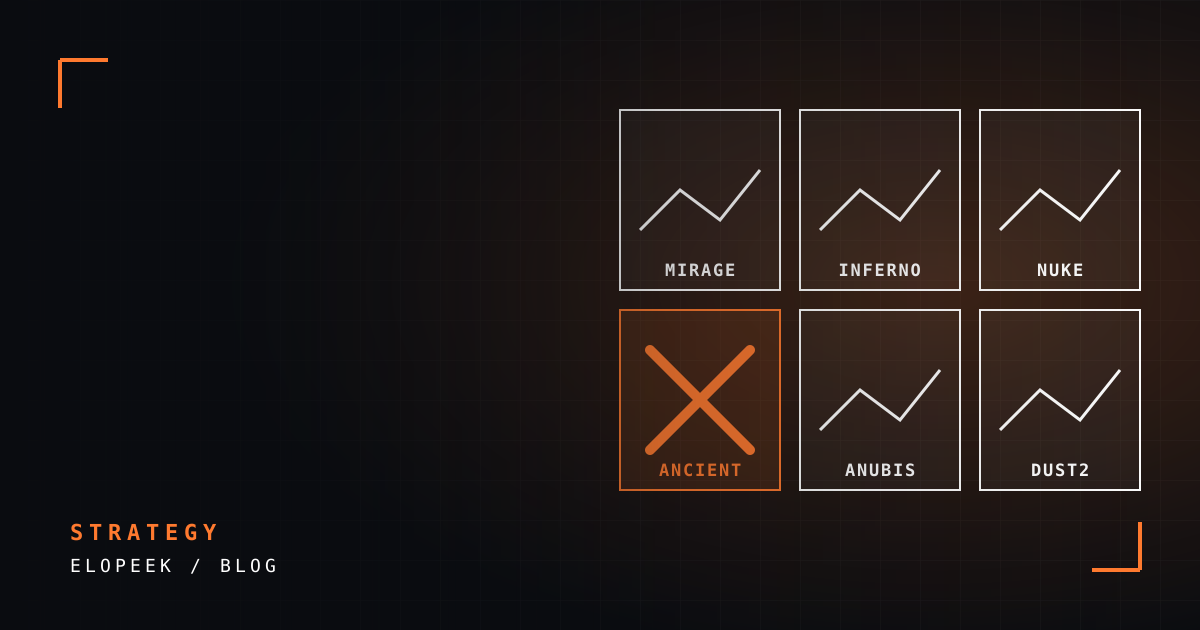
On FACEIT the map veto is often a two-second decision: "I don't like Nuke, ban it." Yet the right map can noticeably raise your chances before the first round starts. This article covers what to look at during the veto and how to read it.
Why the veto matters
Two players at the same Elo can have very different map pools. One might win 65% on Mirage and only 40% on Ancient. Across a full team those differences add up. Playing the wrong map is like starting a man down.
Step 1: Know your own strong maps
The first question is not "what are they good at?" but "what are we good at?" Look at your five players' recent map win rates:
- Maps where most of the team wins 55% or more are maps you should protect.
- Maps that several players rarely or never play are priority bans.
Step 2: Remove the opponent's best map
If one map clearly stands out for the other team (for example a team average above 60%), banning it is usually the safest move. You deny them the place where they feel most comfortable.
Step 3: Watch the sample size
A player who went 3–0 on a map has a 100% win rate that means very little. Give more weight to maps with more games behind them. As a rule of thumb, maps played at least 4–5 times in the last 20 matches give more reliable information.
Step 4: Read both sides together
The best ban is a map where they are strong and you are weak. The opposite, where you are strong and they are weak, is the map you want to end up on. A simple table helps:
| Map | Our win % | Their win % | Decision |
|---|---|---|---|
| Mirage | 62% | 48% | Keep |
| Ancient | 41% | 63% | First ban |
| Inferno | 52% | 51% | Neutral |
The numbers are examples; the point is to read both columns together.
Step 5: Communicate quickly
Veto time is short. Typing a one-line suggestion as soon as you enter the lobby ("ban Ancient, keep Mirage") puts everyone on the same page and prevents last-second panic bans.
Common mistakes
- Banning by personal taste: the map you dislike may be your team's best.
- Only looking at the opponent: the map they are weak on might be one you are weak on too.
- Trusting old data: performance from months ago does not reflect current form. Use a recent window such as the last 20 matches.
In short
A good veto answers three questions: where are we strong, where are they strong, and how reliable is that information? EloPeek helps you answer them in seconds by showing both teams' recent map form and a reasoned ban suggestion right on the veto screen.